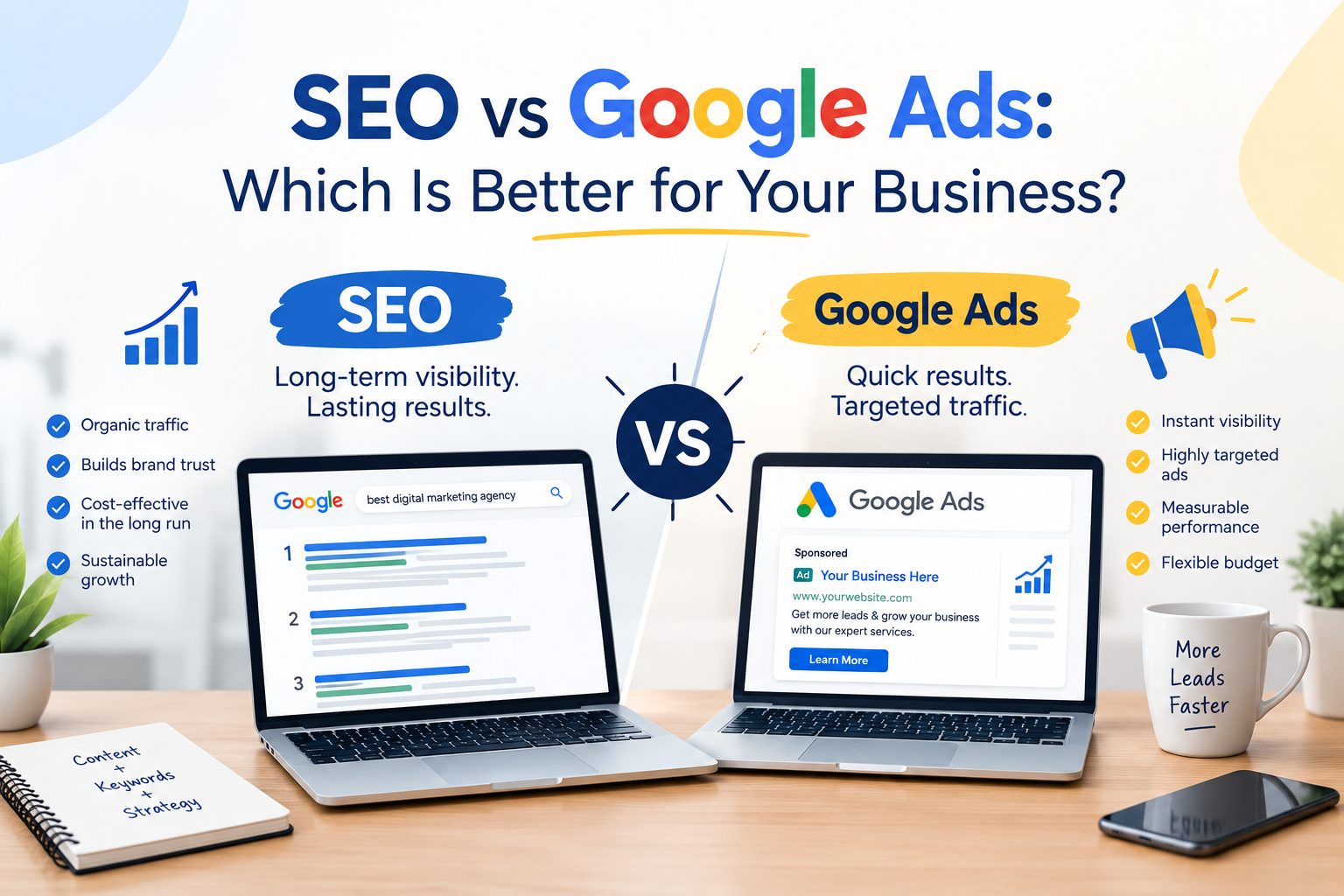
Businesses need a reliable way to reach potential customers online. Two of the most widely used approaches are search engine optimisation (SEO) and Google Ads.
Both can help businesses appear when people search for products, services, or solutions. However, they work differently. SEO focuses on improving organic visibility, while Google Ads allows businesses to pay for placements on Google's search results and other Google properties.
This often leads to an important question: SEO vs Google Ads, which is better for your business?
The answer depends on your goals, budget, competition, industry, and how quickly you need results. For many businesses, the most effective approach is not choosing one over the other but understanding where SEO and PPC can work together.
Search engine optimisation is the process of improving a website and its content so that search engines can better understand and rank its pages for relevant searches.
SEO can involve:
The goal is to earn visibility in organic search results without paying for every click.
SEO generally requires consistent effort. A new website or newly optimised page may take time to gain visibility, particularly in competitive search results.
Google Ads is a paid advertising platform that allows businesses to show ads to people searching for relevant keywords and services.
Businesses can create campaigns around specific objectives and target audiences. Depending on the campaign type, advertisers can pay based on interactions such as clicks.
Google Ads can be useful when a business wants to reach people actively searching for a product or service without waiting for organic rankings to develop.
This is one of the main differences when comparing Google Ads vs SEO. SEO aims to build organic visibility over time. Google Ads provides paid visibility based on campaign settings, targeting, competition, and budget.
| Factor | SEO | Google Ads |
|---|---|---|
| Search visibility | Organic | Paid |
| Initial results | Usually takes time | Can begin quickly after campaigns are approved and running |
| Cost model | Investment in content, optimisation, expertise and other resources | Advertising spend plus campaign management |
| Long-term value | Can continue generating organic traffic after ranking | Traffic generally depends on active campaigns |
| Control | Less direct control over rankings | Greater control over targeting, budget and ad messaging |
| Traffic intent | Can capture informational and commercial searches | Can target specific commercial search intent |
| Best suited for | Long-term organic growth | Faster visibility and targeted acquisition |
| Measurement | Traffic, rankings, conversions and other SEO metrics | Clicks, conversions, cost and campaign performance |
The SEO vs PPC decision should start with the business objective rather than the marketing channel.
If the primary goal is to build sustainable organic visibility and attract relevant search traffic over time, SEO can be a strong investment.
If the goal is to generate targeted traffic quickly, PPC can provide a more immediate route to search visibility.
However, neither channel guarantees conversions by itself. Landing pages, offer quality, targeting, website experience, lead handling, and follow-up also influence the final result.
A well-optimised page can continue attracting organic traffic after it starts ranking. This can make SEO valuable for businesses that want to build a consistent source of search traffic rather than relying entirely on paid campaigns.
SEO encourages businesses to create useful content around the questions and problems their target audience is searching for. Over time, this can help a business establish stronger visibility across multiple relevant searches.
Businesses that consistently generate organic traffic may have less dependence on paid advertising for certain search terms. However, SEO should not be viewed as completely free traffic. Content creation, technical work, optimisation, tools, and expertise all require investment.
SEO can target informational searches as well as commercial and transactional queries. For example, a business can create content that answers early-stage questions while also optimising service pages for people who are closer to making a purchase or enquiry.
One of the biggest advantages of Google Ads is speed. Once a campaign is properly set up and approved, ads can start appearing for relevant searches without waiting for a new webpage to build organic authority. This can be useful for new businesses, new services, seasonal offers, or time-sensitive campaigns.
Google Ads provides businesses with control over factors such as budgets, targeting, keywords, locations, ad messaging, and campaign objectives. This allows marketers to make adjustments based on campaign performance.
Search advertising can be particularly useful when people are actively looking for a service. For example, someone searching for "aesthetic clinic near me" or "healthcare CRM software" may already have a strong commercial intent. A well-structured campaign can place a relevant offer in front of that audience.
Paid campaigns can provide useful data about search terms, messaging, landing pages, and audience response. Businesses can use these insights to improve their broader digital marketing strategy.
For small businesses, the decision can be more complicated because marketing budgets are often limited.
SEO vs Google Ads for small businesses should be evaluated according to the business's stage and immediate priorities.
A business launching a new service may use Google Ads to generate initial visibility and enquiries while building its SEO foundation. Another business with an established website and a strong content strategy may prioritise SEO to build organic traffic over time.
Small businesses should also consider the competitiveness of their target keywords. Highly competitive commercial keywords can require significant paid advertising budgets, while ranking organically for the same terms may also take substantial time and effort.
A balanced strategy can allow businesses to generate short-term opportunities while continuing to build long-term organic visibility.
One of the most common questions is SEO vs PPC which gives better ROI?
There is no universal answer.
The return on investment depends on factors such as:
Google Ads can provide faster data and measurable campaign costs, while SEO can generate ongoing organic traffic after successful rankings are established.
For this reason, businesses should compare both channels based on cost per qualified lead, conversion rate, customer acquisition cost, and revenue, rather than simply looking at traffic or clicks.
If you are asking, should I invest in SEO or Google Ads, consider these situations.
Choose SEO when:
Consider Google Ads when:
Consider using both when:
SEO and paid search do not necessarily need to compete for the same budget. They can support different stages of a broader acquisition strategy.
For example, Google Ads can help generate immediate traffic for high-intent searches while SEO builds organic visibility around related service pages, guides, and informational content.
Paid search data can also provide insights into which keywords and messages generate clicks or conversions. These insights can inform content and landing-page strategies.
At the same time, strong organic visibility can provide additional opportunities to reach users who may not click on paid advertisements.
The two channels can therefore be evaluated as complementary parts of a search marketing strategy.
Luhaif Digitech helps businesses build and manage digital marketing strategies across channels such as SEO, Google Ads, performance marketing, content, and other digital growth activities.
Instead of looking at SEO and paid advertising as completely separate activities, a digital marketing strategy can bring these channels together based on the business's goals, audience, competition, and budget.
For SEO, this can include keyword research, content planning, on-page optimisation, technical SEO, local SEO, and ongoing performance analysis.
For paid campaigns, the focus can include campaign planning, keyword targeting, ad optimisation, landing-page alignment, budget management, and performance tracking.
The broader objective is to connect marketing activity with measurable business outcomes rather than focusing only on traffic numbers.
For businesses deciding between SEO vs Google Ads, the right strategy starts with understanding where the business is today and what it needs to achieve next.
There is no single answer to the SEO vs Google Ads debate.
SEO can help businesses build long-term organic visibility, while Google Ads can provide faster access to targeted search traffic. The right approach depends on the business's objectives, budget, competition, audience, and growth stage.
For many businesses, combining both channels can provide a practical search marketing strategy. Paid campaigns can support immediate lead generation while SEO builds organic visibility over time.
But generating traffic is only part of the process. Businesses also need relevant landing pages, effective follow-up processes, and a clear way to measure conversions.
If you are looking to build a stronger search presence or generate more qualified enquiries through digital marketing, Luhaif Digitech can help you develop a strategy around your business goals.
1. SEO vs Google Ads: which is better for a business?
Neither is universally better. SEO is generally suited to long-term organic visibility, while Google Ads can provide faster access to targeted search traffic. The right option depends on the business's goals, budget, competition, and timeline.
2. Is SEO better than PPC for long-term growth?
SEO can be valuable for long-term growth because successful organic rankings can continue generating traffic without paying for every click. However, maintaining organic visibility still requires ongoing optimisation and content investment.
3. How quickly can Google Ads generate results?
Google Ads can begin generating visibility and traffic once campaigns are approved and running. However, performance depends on factors such as targeting, competition, ad quality, landing pages, budget, and conversion rates.
4. Should small businesses invest in SEO or Google Ads?
Small businesses should consider their immediate goals and available resources. Google Ads can help generate faster visibility, while SEO can build organic search traffic over time. In many cases, using both strategically can be effective.
5. SEO vs PPC: which gives better ROI?
There is no fixed answer. ROI depends on factors such as acquisition cost, lead quality, conversion rates, customer value, keyword competition, and the time required to generate results. Businesses should compare both channels using qualified leads and actual conversions.
6. Can SEO and Google Ads be used together?
Yes. SEO and Google Ads can complement each other. Businesses can use paid campaigns for immediate visibility while building organic rankings through SEO.
7. How can I track leads generated from SEO and Google Ads?
A CRM can help businesses track incoming leads, their sources, follow-up activity, appointments, and conversions. This provides a clearer picture of what happens after someone clicks an advertisement or discovers the business through organic search.


17153 STE 1 Bear Valley RdHesperia, CA 92345, USA

Block-d, Balaji Estate, Guru Ravidas Marg, Kalkaji, New Delhi-110019

123 Arabian Drive, Suite 306, Fort McMurray, Alberta, Canada T9H 5N9

201, Al Reyami building, Umm Hurair street, Dubai
Copyright © 2023 - 2024 Luhaif Digitech. All rights reserved.