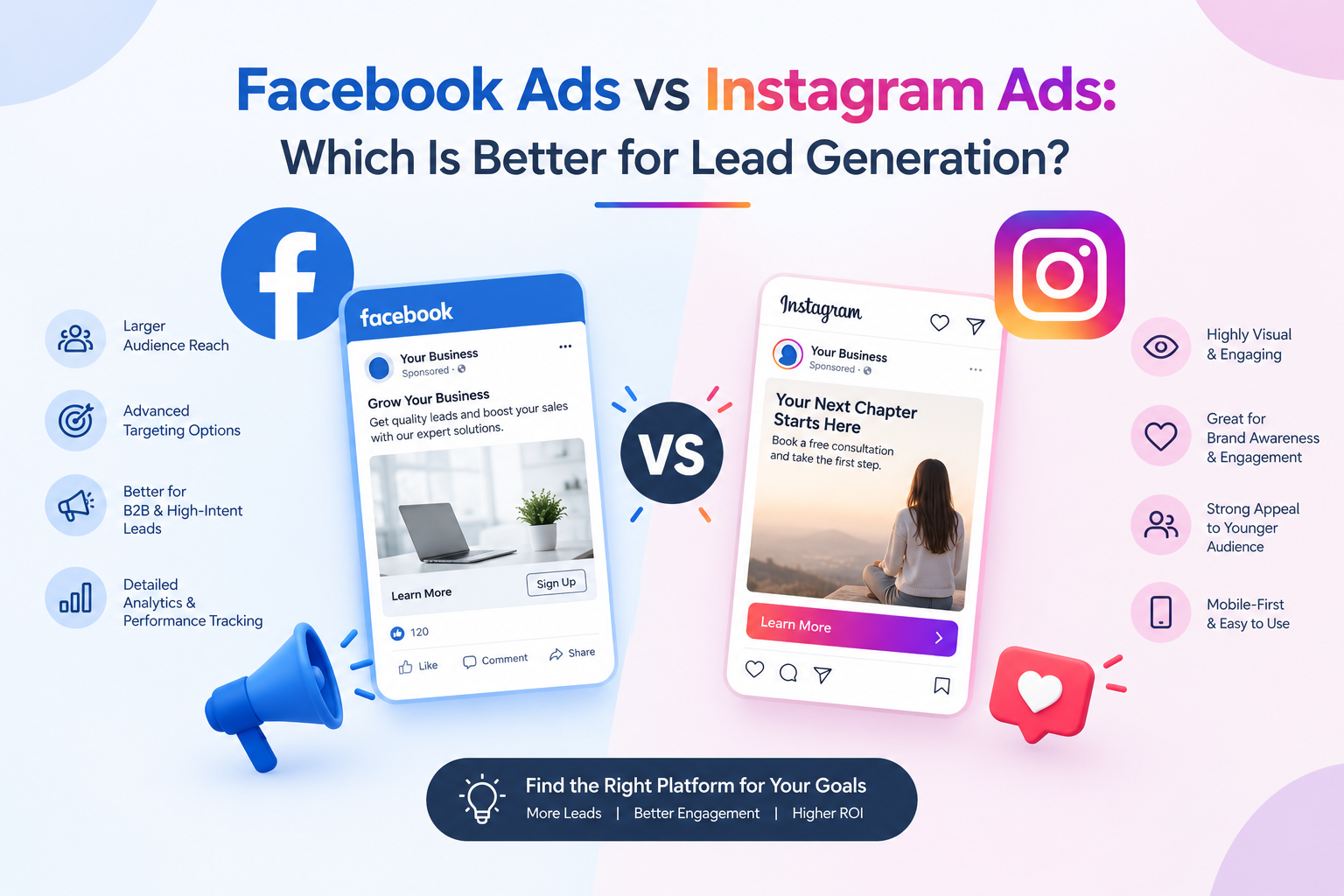
Social media advertising has become an important part of digital marketing. Businesses use paid campaigns to reach new customers, promote services, and generate leads.
Two of the most popular platforms for this are Facebook and Instagram.
Both platforms are part of Meta and offer powerful advertising options. Yet, they do not always work in the same way. The audience, content format, engagement patterns, and user behaviour can vary between them.
This often leads to an important question: Facebook Ads vs Instagram Ads, which is better for lead generation?
There is no single answer.
The better platform depends on the business, target audience, offer, and campaign objective. Understanding the differences can help businesses spend their advertising budget more effectively.
Facebook and Instagram advertising are managed through Meta's advertising system. Businesses can create campaigns, define their target audience, set budgets, and track results through the same advertising ecosystem.
The major difference lies in how people use each platform.
Facebook has a broad user base and supports many types of content. Users interact with pages, groups, videos, posts, events, and communities.
Instagram is highly visual. Photos, Reels, Stories, and short-form videos play a major role in user engagement.
These differences can affect lead generation.
A service business targeting working professionals may find Facebook useful for detailed messaging and lead forms. A beauty, fashion, fitness, or lifestyle brand may find Instagram more effective for visually showcasing its services.
Facebook has remained a strong platform for businesses looking to generate leads.
One major advantage is its wide audience. Businesses can target users based on demographics, interests, behaviours, location, and other available signals.
Facebook also offers several advertising formats. These include image ads, video ads, carousel ads, and lead ads.
Facebook Lead Ads can be particularly useful for businesses that want to collect customer information without sending users to a separate landing page.
A user can submit details such as their name, phone number, or email directly through a form.
This reduces the number of steps between seeing an advertisement and becoming a lead.
Instagram can be effective for brands that depend heavily on visual communication.
The platform allows businesses to promote their products and services through Reels, Stories, Feed ads, and other placements.
Strong visuals can quickly capture attention. This makes Instagram useful for businesses where appearance and presentation influence purchase decisions.
For example, a salon can showcase transformations. A fitness brand can share workout content. A restaurant can display dishes. An interior design company can show completed projects.
Instagram lead generation can also benefit from direct interactions. Users may discover a business through an ad and then visit its profile, send a message, or complete a lead form.
The answer depends on what you are trying to achieve.
Facebook can be a strong choice when the campaign requires detailed targeting, broader audience reach, or direct lead forms.
Instagram can work well when visual content is central to the offer and the target audience spends significant time engaging with visual media.
For many businesses, the best strategy is not choosing one platform permanently.
Meta Ads can distribute campaigns across Facebook and Instagram while using performance data to identify where results are stronger.
Testing both platforms can provide more useful information than relying on assumptions.
Small businesses often have limited advertising budgets. Every lead matters.
This makes platform selection especially important.
Facebook or Instagram Ads for small business should be selected based on the audience and type of offer.
A local service provider may benefit from Facebook's broad targeting and community-oriented environment. A clothing store may see stronger engagement on Instagram.
Consider the following:
Choose Facebook when:
Choose Instagram when:
These are starting points, not fixed rules.
Actual campaign performance should always guide the final decision.
One of the biggest mistakes businesses make is choosing a platform based only on popularity.
The more important question is where your potential customers spend their time.
Suppose you run a B2B consulting company. Your audience may respond better to professional and educational content.
Now consider a skincare brand. Visual demonstrations, product videos, and creator-style content may perform better on Instagram.
The platform should match the customer's behaviour.
Research your existing customers. Look at their age, interests, location, buying behaviour, and preferred content formats.
These insights can help you make a more informed decision.
A good platform cannot compensate for weak creative.
Your advertisement needs to capture attention and communicate value quickly.
On Facebook, longer copy can sometimes work well when the offer requires context. A clear headline and strong call to action can help users understand what they should do next.
Instagram often requires a more visual approach.
The first few seconds of a Reel can determine whether someone continues watching. Strong imagery, clear text, and a simple message can make the advertisement more effective.
The creative should also match the placement.
A video created for Instagram Reels may not work equally well as a Facebook Feed advertisement.
Getting hundreds of leads sounds impressive.
But numbers alone do not tell the full story.
A campaign generating 500 low-quality leads may be less valuable than one generating 100 genuine prospects.
Businesses should therefore track lead quality.
Look at metrics such as:
This gives a clearer picture of campaign performance.
A platform with a higher cost per lead may still produce better customers. That makes it more valuable in the long run.
Businesses can improve Facebook lead generation by focusing on both targeting and the offer.
Start with a specific audience. Avoid targeting everyone.
Create an offer that gives people a reason to submit their information. It could be a consultation, product enquiry, demo, discount, assessment, or downloadable resource.
Keep the lead form simple. Asking for too many details can discourage users from completing it.
The follow-up process also matters.
A lead that receives a response quickly is more likely to stay interested. CRM systems and automated workflows can help businesses manage this process.
Instagram campaigns should make the value of the offer clear.
Use high-quality visuals and short, focused messages. Reels can demonstrate products or services. Stories can create urgency. Carousel ads can explain multiple benefits.
The call to action should be straightforward.
Tell users what to do next. They may need to fill out a form, send a message, visit a website, or book a consultation.
Consistency is also important.
A person who clicks an Instagram ad may visit the brand's profile before becoming a lead. The profile should therefore support the same message and build trust.
Businesses do not always have to treat Facebook and Instagram as completely separate advertising channels.
Meta Ads can allow advertisers to manage campaigns across both platforms.
This gives businesses an opportunity to test different audiences, placements, creatives, and messages.
Performance data can then show where leads are coming from.
For example, Instagram may generate more enquiries, while Facebook may generate leads at a lower cost. Another campaign may show the opposite.
There is no universal winner.
The best Meta Ads platform for lead generation is the one that produces valuable results for a particular business.
In many cases, yes.
Running campaigns across both platforms can expand reach and give Meta more data to optimise delivery.
However, this does not mean businesses should simply duplicate the same creative everywhere.
Adapt content to the platform.
Use visually strong videos for Instagram. Test detailed messaging on Facebook.
Experiment with different calls to action.
Most importantly, compare the quality of leads generated through each placement.
Managing leads manually becomes difficult as campaigns grow.
AI and automation can help businesses handle this process more efficiently.
Automated systems can organise incoming leads, send follow-up messages, assign leads to team members, and track customer interactions.
AI can also help identify patterns in campaign performance. Businesses can use these insights to understand which audiences and messages are producing better results.
This creates a more connected process.
The advertisement generates the lead. Automation manages the lead. The sales team works on conversion.
So, Facebook Ads vs Instagram Ads for lead generation, which one should you choose?
There is no platform that is automatically better for every business.
Facebook can be valuable for broad targeting, detailed messaging, and direct lead forms. Instagram can be powerful for visual brands, short-form content, and highly engaging creative.
The right choice depends on your audience and business goals.
Testing both platforms is often the most practical approach. Track cost per lead, lead quality, conversions, and revenue. Then invest more in the channel that delivers stronger business results.
Running successful Meta campaigns involves more than creating an advertisement.
Businesses need the right audience, creative strategy, campaign structure, tracking, and lead management process.
Luhaif Digitech helps businesses build and improve their digital marketing strategies with technology-driven solutions. Its approach can help businesses make better use of digital channels, automation, data, and performance insights.
A well-planned advertising strategy can connect campaigns with the rest of the customer journey. This makes it easier to track leads and understand what is actually driving growth.
There is no fixed winner between Facebook and Instagram. Both can bring strong leads when the campaign is built around the right audience and offer.
The real difference comes down to how your customers use each platform. Some audiences may respond better to detailed Facebook campaigns. Others may engage more with Instagram Reels, Stories, and visual content.
Instead of relying on assumptions, businesses should test both platforms and study the results. Cost per lead is important, but lead quality, enquiries, appointments, and final conversions matter even more.
A successful Meta Ads campaign is not only about getting people to click. It is about reaching the right people and giving them a reason to take the next step.
Good advertising should continue working after a person submits an enquiry.
Lead tracking, timely follow-ups, audience insights, and campaign optimisation can make a major difference to the final outcome.
This is where the right digital strategy can help.
Luhaif Digitech helps businesses strengthen their digital marketing efforts through technology, automation, data, and performance-focused solutions. The goal is to create a smoother path between advertising, lead generation, and customer conversion.
If your business is investing in Facebook or Instagram advertising, the next step is to make every lead count.
Talk to Luhaif Digitech to build a smarter digital marketing strategy for your business.


17153 STE 1 Bear Valley RdHesperia, CA 92345, USA

Block-d, Balaji Estate, Guru Ravidas Marg, Kalkaji, New Delhi-110019

123 Arabian Drive, Suite 306, Fort McMurray, Alberta, Canada T9H 5N9

201, Al Reyami building, Umm Hurair street, Dubai
Copyright © 2023 - 2024 Luhaif Digitech. All rights reserved.