Getting people to visit an online store is only the first step.
The real challenge starts after that.
A visitor needs to find the right product. The product page needs to build confidence. The checkout process needs to feel simple. The brand also needs to stay in front of customers after the first purchase.
This is why digital marketing for e-commerce businesses needs a complete strategy.
A few social media posts or occasional Google Ads may bring traffic. They may not create consistent sales.
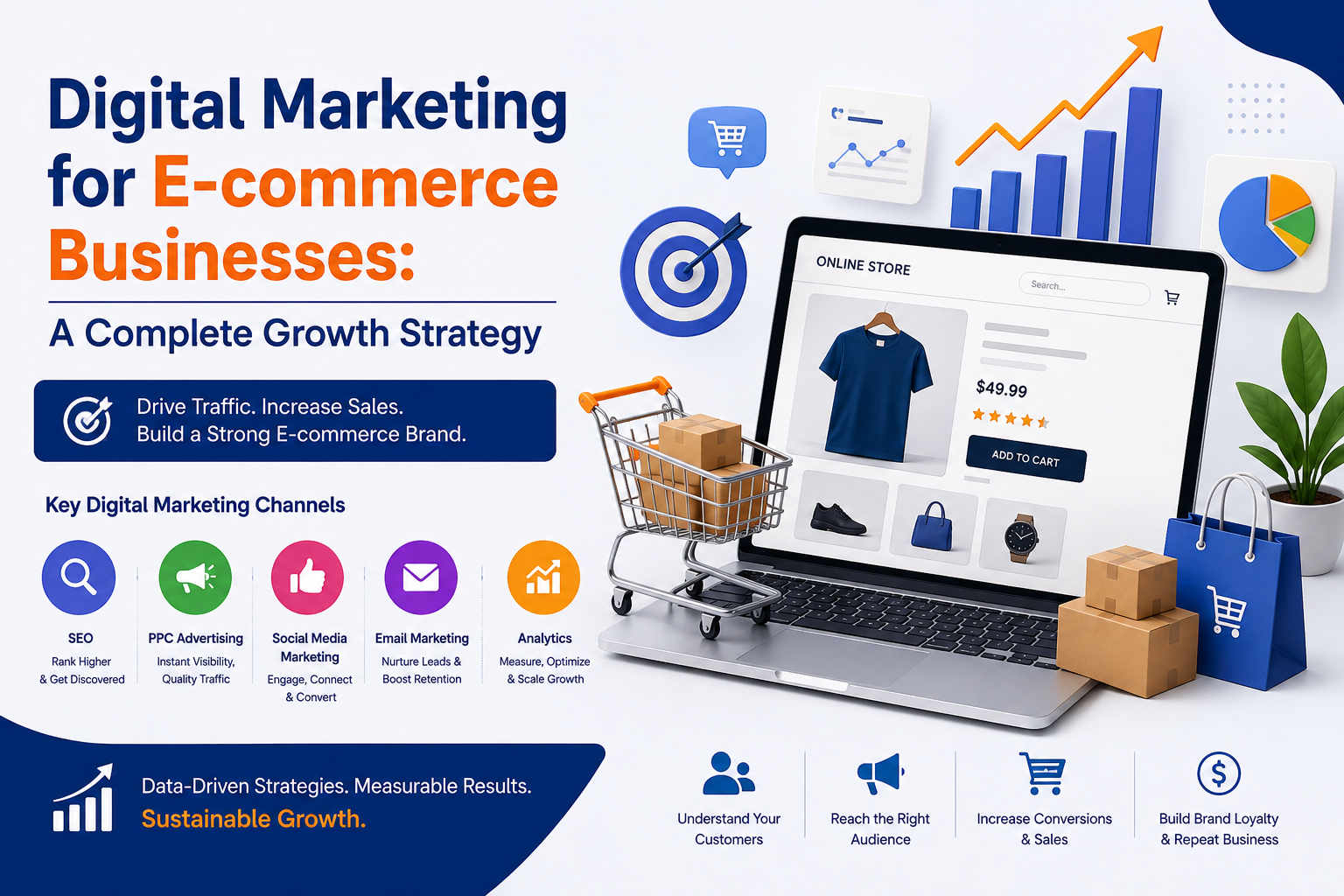
E-commerce growth comes from connecting different digital channels. Search, paid advertising, social media, content and customer retention all have a role.
An e-commerce brand has many touchpoints.
A customer may discover a product on Instagram. They may search for reviews on Google. They may visit the website and leave without buying. A retargeting ad may bring them back later.
The journey can take several steps.
A good e-commerce marketing strategy should account for this entire journey.
The focus should not be only on traffic. It should also consider product views, add-to-cart activity, purchases, repeat orders and customer value.
This gives businesses a clearer picture of what is driving growth.
Before spending money on advertising, understand who you are trying to reach.
Different products attract different buyers.
Age, location, interests, purchasing behaviour and spending patterns can all influence the campaign.
Customer research can also reveal useful information.
What problem does the product solve?
What stops people from buying?
What features matter most?
What questions do customers ask before purchasing?
These insights can shape your content, advertisements and product pages.
A strong strategy starts with the customer rather than the platform.
Your website is where marketing efforts often turn into sales.
You can have excellent ads and strong social media content. A confusing website can still lose the customer.
Product pages should make important information easy to find.
This includes:
Mobile experience is equally important.
Many shoppers browse and purchase through their phones. Pages should load quickly and remain easy to navigate on smaller screens.
Good e-commerce digital marketing brings people to the website. A good website gives them a reason to buy.
Search engines can become a major source of long-term traffic.
People search for products, comparisons, solutions and reviews before making purchases.
E-commerce SEO helps your products and categories appear for relevant searches.
Keyword research is an important starting point.
But SEO goes beyond keywords.
Product titles, descriptions, category pages, internal links, technical performance and useful content all matter.
Product pages should also answer real customer questions.
If someone searches for a specific product, the page should provide enough information to help them make a decision.
This can improve both visibility and the shopping experience.
Organic traffic takes time.
Paid advertising can help an e-commerce brand reach potential customers faster.
E-commerce PPC can be particularly useful for products with clear search demand.
Google Shopping campaigns can showcase products when people are actively searching. Search campaigns can target specific queries. Display and remarketing campaigns can help bring previous visitors back.
Meta can play a different role.
Instagram and Facebook can introduce products to new audiences through visual content. Retargeting can also remind previous visitors about products they viewed.
The key is not to run ads everywhere.
Choose platforms based on where your customers are and how they make purchase decisions.
E-commerce social media marketing should do more than increase followers.
Social platforms can help customers discover products and understand how they fit into their lives.
Product demonstrations can answer questions. Customer reviews can build trust.
Short videos can show the product in use. User-generated content can make the brand feel more authentic.
Social media can also support launches and seasonal campaigns.
The content should match the buying stage.
Someone discovering your brand needs different content from someone who has already visited your product page.
Not every visitor will purchase on the first visit.
Some may still be comparing products. Others may want a discount. Some may simply need more information.
This is where e-commerce lead generation can help.
Email sign-ups, offers, product alerts and abandoned-cart campaigns can help businesses stay connected with potential customers.
Retargeting is another important tool.
A customer who viewed a product but did not buy can be shown a relevant reminder later.
The objective is not to follow every visitor with advertisements.
It is to create useful follow-up opportunities.
Getting a new customer can require significant effort.
Keeping that customer can be just as important.
Post-purchase communication can encourage repeat purchases. Product recommendations can introduce related items. Loyalty programmes can give customers a reason to return.
Brands should also monitor customer behaviour.
Which products generate repeat orders?
Which customers buy frequently?
Which offers encourage another purchase?
These insights can improve future campaigns.
A successful e-commerce growth strategy looks beyond the first transaction.
Digital marketing generates a lot of data.
But not every number deserves equal attention.
Website traffic is useful. Impressions are useful. Engagement can also provide insights.
Sales tell a different story.
E-commerce brands should monitor metrics such as conversion rate, customer acquisition cost, average order value, return on ad spend and repeat purchase rate.
These numbers show where the business is gaining or losing money.
Campaigns can then be adjusted based on actual performance.
Managing multiple channels can become difficult as an e-commerce business grows.
SEO needs continuous work. Paid campaigns need optimisation. Social media needs fresh content. Customer data needs to be reviewed.
This is where an experienced e-commerce marketing agency can add value.
Luhaif Digitech offers services across SEO, performance marketing, social media marketing, content marketing and lead generation. Its broader digital marketing approach allows different channels to work together instead of operating as isolated campaigns.
For an e-commerce brand, this can create a more connected customer journey.
Search can bring new visitors. Paid campaigns can capture demand. Social media can build product awareness. Retargeting can bring interested shoppers back.
The strategy can then be refined using performance data.
There is no single platform that guarantees e-commerce growth.
SEO can build long-term visibility.
PPC can capture high-intent traffic.
Social media can create discovery.
Content can build trust.
Email and retargeting can support repeat purchases.
The strongest strategy connects these activities.
That is the real value of e-commerce digital marketing.
Your goal should not be to simply attract more visitors.
It should be to attract the right visitors, convert them into customers and give them reasons to return.
For e-commerce brands ready to scale, a structured approach can make digital marketing more measurable, efficient and sustainable.
1. What is digital marketing for e-commerce businesses?
It involves using channels such as SEO, PPC, social media, content marketing, email and paid advertising to attract shoppers, increase sales and retain customers.
2. Which digital marketing strategy is best for e-commerce?
A combination of SEO, paid advertising, social media, content and retention usually works better than relying on one channel.
3. How does e-commerce SEO help online stores?
E-commerce SEO can improve visibility for product, category and informational searches. It can help bring relevant organic traffic to an online store.
4. How can e-commerce businesses generate more leads?
Brands can use email sign-ups, offers, product alerts, retargeting, social campaigns and useful content to capture and nurture potential customers.
5. How can an e-commerce marketing agency help?
An agency can develop and manage SEO, paid advertising, social media, content and lead generation while tracking performance and improving campaigns over time.


17153 STE 1 Bear Valley RdHesperia, CA 92345, USA

Block-d, Balaji Estate, Guru Ravidas Marg, Kalkaji, New Delhi-110019

123 Arabian Drive, Suite 306, Fort McMurray, Alberta, Canada T9H 5N9

201, Al Reyami building, Umm Hurair street, Dubai
Copyright © 2023 - 2024 Luhaif Digitech. All rights reserved.