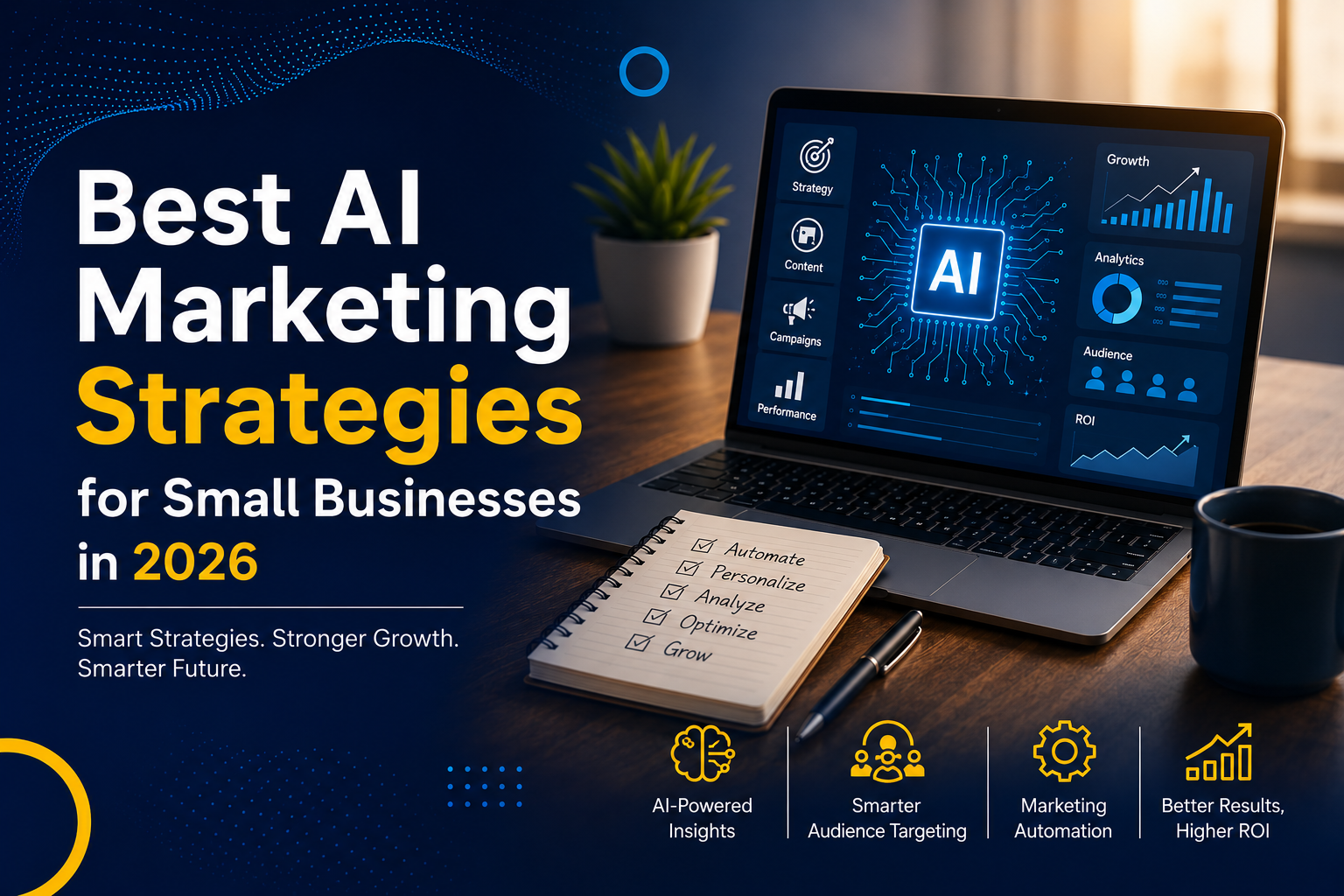
Running a small business today is more challenging than ever. Customers expect personalized experiences, quick responses, and seamless interactions across multiple digital platforms. At the same time, competition is increasing, advertising costs are rising, and consumer behavior continues to evolve. For many small businesses, achieving consistent growth with limited budgets and resources can feel overwhelming.
This is where Artificial Intelligence (AI) is transforming the way businesses market themselves. Once considered a technology reserved for large corporations, AI is now accessible to businesses of every size. It enables small businesses to automate repetitive tasks, understand customer behavior, optimize marketing campaigns, and generate better leads without significantly increasing costs.
The biggest advantage of AI isn't replacing human marketers. It's empowering businesses to make smarter decisions backed by data, helping them save time while delivering better results.
Whether you own a local business, an e-commerce store, a healthcare practice, or a professional service firm, adopting the right AI marketing strategies can help you compete with larger brands and build sustainable growth.
In this guide, we'll explore the best AI marketing strategies for small businesses, practical examples of how they work, and how businesses can use AI to improve their marketing performance in 2026.
Small businesses often have limited marketing teams and tighter budgets. Managing SEO, social media, paid advertising, content creation, email marketing, and customer engagement manually can quickly become time-consuming.
AI helps businesses automate these repetitive processes while providing valuable insights that would otherwise require hours of manual analysis.
Instead of guessing what customers want, AI analyzes data to identify patterns, predict customer behavior, and recommend actions that improve marketing performance.
Some of the biggest benefits of AI marketing include:
Rather than replacing creativity, AI allows marketers to spend more time developing strategies while technology handles repetitive work.
One of the biggest reasons businesses are shifting toward AI-powered marketing is the ability to make faster, data-driven decisions.
| Traditional Marketing | AI Marketing |
|---|---|
| Broad audience targeting | Precision audience targeting using customer data |
| Manual campaign optimization | Real-time AI-powered optimization |
| Generic customer communication | Personalized customer experiences |
| Limited campaign insights | Predictive analytics and detailed reporting |
| Manual reporting | Automated performance tracking |
| Difficult to scale | Easily scalable across multiple channels |
For small businesses, this means achieving better marketing results without significantly increasing resources or budget.
Every successful marketing campaign begins with understanding your customers. Unfortunately, many businesses still rely on assumptions instead of actual customer data.
AI changes this by collecting and analyzing customer information from multiple sources, including website visits, social media interactions, purchase history, search behavior, and customer inquiries.
Instead of simply knowing who your customers are, AI helps you understand why they make purchasing decisions.
When businesses understand customer behavior, they can create campaigns that address real customer needs instead of making educated guesses.
For example, an online clothing store may discover through AI analytics that a large percentage of visitors browse products on mobile devices during evening hours. This insight allows the business to schedule promotions when customers are most active, improving engagement and conversions.
Generating quality leads is one of the biggest challenges for small businesses. Sorting through hundreds of inquiries manually often results in missed opportunities and slower response times.
AI-powered lead generation tools automatically identify visitors who show strong buying intent based on their online behavior.
These systems can monitor website activity, analyze customer interactions, score leads, and prioritize prospects who are most likely to convert.
Imagine a dental clinic receiving dozens of appointment inquiries every week. Instead of manually following up with every inquiry, AI identifies visitors who viewed treatment pages multiple times, downloaded pricing information, or submitted consultation forms. These prospects are automatically marked as high-priority leads, allowing the clinic to respond faster and improve appointment bookings.
Many businesses partnering with AI-focused digital agencies like Luhaif Digitech are adopting intelligent lead management systems to reduce response time and improve customer acquisition without increasing operational costs.
Today's customers expect brands to understand their preferences. Generic advertisements and mass email campaigns are becoming less effective because consumers want experiences that feel relevant to them.
AI makes personalization easier by analyzing customer behavior and automatically delivering tailored content.
Whether it's recommending products, sending personalized emails, or displaying customized website content, AI helps businesses create more meaningful interactions.
People are far more likely to engage with businesses that provide relevant recommendations.
For example, if a customer regularly purchases skincare products from an online store, AI can recommend complementary products instead of showing unrelated offers.
This creates a better customer experience while increasing average order value.
The result is stronger customer relationships and improved brand loyalty.
Search Engine Optimization remains one of the most effective long-term marketing strategies for small businesses. However, SEO has become increasingly competitive, requiring businesses to understand search intent, optimize content, and monitor technical performance continuously.
AI simplifies many aspects of SEO by helping businesses make smarter optimization decisions.
Instead of spending hours researching keywords or auditing websites manually, AI-powered SEO tools can analyze large amounts of data within minutes.
For example, instead of targeting a broad keyword like digital marketing, AI may recommend long-tail keywords such as AI marketing strategies for small businesses because they align better with user intent and face less competition.
At Luhaif Digitech, AI-driven SEO isn't just about finding keywords. It involves understanding how customers search, what information they expect, and how businesses can create content that genuinely answers their questions while improving search visibility.
Content remains the foundation of digital marketing. Blogs, landing pages, social media posts, videos, and email campaigns all help businesses educate customers and build trust.
However, consistently creating valuable content requires significant time and effort.
AI can support content marketing by assisting with research, identifying trending topics, suggesting keywords, generating outlines, and optimizing readability.
This doesn't mean AI should replace human writers.
The best-performing content combines AI-powered insights with human creativity, industry expertise, and strategic thinking.
For example, AI can identify that people are searching for "best AI marketing strategies for small businesses," but experienced marketers understand how to turn that keyword into a helpful, engaging article that answers real customer questions.
This balance between technology and human expertise is what allows businesses to create content that performs well in search engines while remaining useful and trustworthy for readers.
Paid advertising can deliver excellent results, but only when campaigns are managed effectively. Many small businesses struggle because they target broad audiences, spend money on the wrong keywords, or fail to optimize their campaigns regularly.
AI removes much of this guesswork by continuously analyzing campaign performance and making data-driven recommendations.
Instead of manually adjusting bids or monitoring every metric, AI helps businesses understand what's working and where improvements are needed. It can identify the audiences most likely to convert, recommend the best times to display ads, and optimize budgets based on real-time performance.
Imagine you're a local fitness studio running Google Ads.
Instead of showing the same advertisement to everyone searching for "gym near me," AI analyzes factors like search history, location, device, demographics, and browsing behavior. It then prioritizes users who are actively looking for memberships or fitness classes, increasing the likelihood of generating qualified leads while reducing unnecessary ad spend.
Rather than relying solely on automation, agencies like Luhaif Digitech combine AI-powered campaign analysis with expert marketing strategies to ensure every advertising decision aligns with business goals.
Customers expect businesses to respond quickly, regardless of the time of day. Delayed responses often lead to missed opportunities, especially when potential customers are comparing multiple businesses.
AI-powered chatbots help solve this challenge by providing instant assistance 24/7.
Modern AI chatbots do much more than answer frequently asked questions. They can qualify leads, recommend products or services, schedule appointments, collect customer information, and even guide users through the buying process.
A patient visits a dermatology clinic's website at 11:30 PM to inquire about laser hair reduction.
Instead of waiting until the next business day, an AI chatbot answers common questions, explains the treatment, collects contact information, and schedules a consultation request. By the time the clinic opens, the sales team already has a qualified lead ready for follow-up.
Despite the growth of social media, email marketing remains one of the highest-performing digital marketing channels.
However, sending the same email to every customer rarely produces the best results.
AI enables businesses to create personalized email campaigns based on customer interests, purchase history, browsing behavior, and previous interactions.
Instead of manually segmenting audiences, AI automatically groups customers into relevant categories and sends emails that are more likely to generate engagement.
This makes email marketing more relevant, improving open rates, click-through rates, and conversions.
One of AI's biggest advantages is its ability to predict future customer behavior instead of simply analyzing past performance.
Predictive analytics helps businesses anticipate what customers are likely to do next, allowing them to plan marketing campaigns more effectively.
Imagine an online electronics store preparing for the festive season. Instead of waiting for sales data after launching promotions, AI predicts which product categories are expected to experience the highest demand based on historical trends and customer behavior.
This enables the business to adjust inventory, marketing budgets, and promotional campaigns in advance.
Smarter planning leads to better customer experiences and higher profitability.
One of the biggest mistakes businesses make is launching marketing campaigns without regularly measuring their performance.
AI-powered analytics tools provide real-time insights that help businesses understand exactly what's working and what needs improvement.
Instead of waiting until the campaign ends, businesses can optimize their strategies while campaigns are still running.
These insights allow businesses to make informed decisions backed by data rather than assumptions.
Although AI offers enormous opportunities, success depends on how it's implemented.
Here are some common mistakes businesses should avoid.
AI can automate tasks and generate insights, but it cannot replace human creativity, strategic thinking, or industry expertise. Businesses should use AI as a support tool rather than a replacement for skilled marketers.
AI is only as effective as the data it receives. Outdated or inaccurate customer information often leads to poor recommendations and ineffective campaigns.
Many businesses invest in AI software without defining clear marketing objectives. Technology works best when it supports a well-planned strategy.
AI can speed up content creation, but every piece of content should be reviewed for accuracy, originality, and brand consistency before publication.
Marketing is ultimately about building relationships with customers. Businesses should combine AI efficiency with authentic human communication.
AI continues to evolve rapidly, and businesses that embrace it today will be better prepared for tomorrow's digital landscape.
Some of the biggest AI marketing trends shaping the future include:
As AI becomes more sophisticated, businesses that combine technology with strategic marketing will gain a significant competitive advantage.
Implementing AI isn't simply about purchasing software. The real value lies in knowing how to use AI effectively to solve business challenges and deliver measurable results.
At Luhaif Digitech, we believe AI should support business growth, not complicate it. Our approach combines AI-powered technology with experienced digital marketing professionals who understand how to translate data into actionable strategies.
Whether it's improving search rankings through AI-driven SEO, running high-performing paid advertising campaigns, automating customer engagement, or creating content that aligns with user intent, every strategy is designed around the unique goals of each business.
Instead of offering one-size-fits-all solutions, Luhaif Digitech develops customized AI marketing strategies that help small businesses attract qualified leads, improve online visibility, increase conversions, and maximize return on investment.
Our focus isn't simply on using AI. It's on using AI intelligently to help businesses achieve sustainable, long-term growth.
Artificial Intelligence is no longer a luxury reserved for large enterprises. It has become an essential tool for small businesses looking to compete in today's digital marketplace.
From understanding customer behavior and improving SEO to automating lead generation, personalizing customer experiences, and optimizing advertising campaigns, AI enables businesses to market more efficiently while making better use of their time and budget.
However, technology alone isn't enough. The most successful businesses combine AI-powered insights with human creativity, strategic planning, and continuous optimization.
If you're looking to build a smarter marketing strategy, improve customer engagement, and achieve sustainable business growth, adopting AI is one of the most valuable investments you can make.
Partnering with an experienced AI marketing agency like Luhaif Digitech can help you unlock the full potential of AI, ensuring every marketing effort is backed by data, driven by strategy, and focused on delivering measurable business results.


17153 STE 1 Bear Valley RdHesperia, CA 92345, USA

Block-d, Balaji Estate, Guru Ravidas Marg, Kalkaji, New Delhi-110019

123 Arabian Drive, Suite 306, Fort McMurray, Alberta, Canada T9H 5N9

201, Al Reyami building, Umm Hurair street, Dubai
Copyright © 2023 - 2024 Luhaif Digitech. All rights reserved.